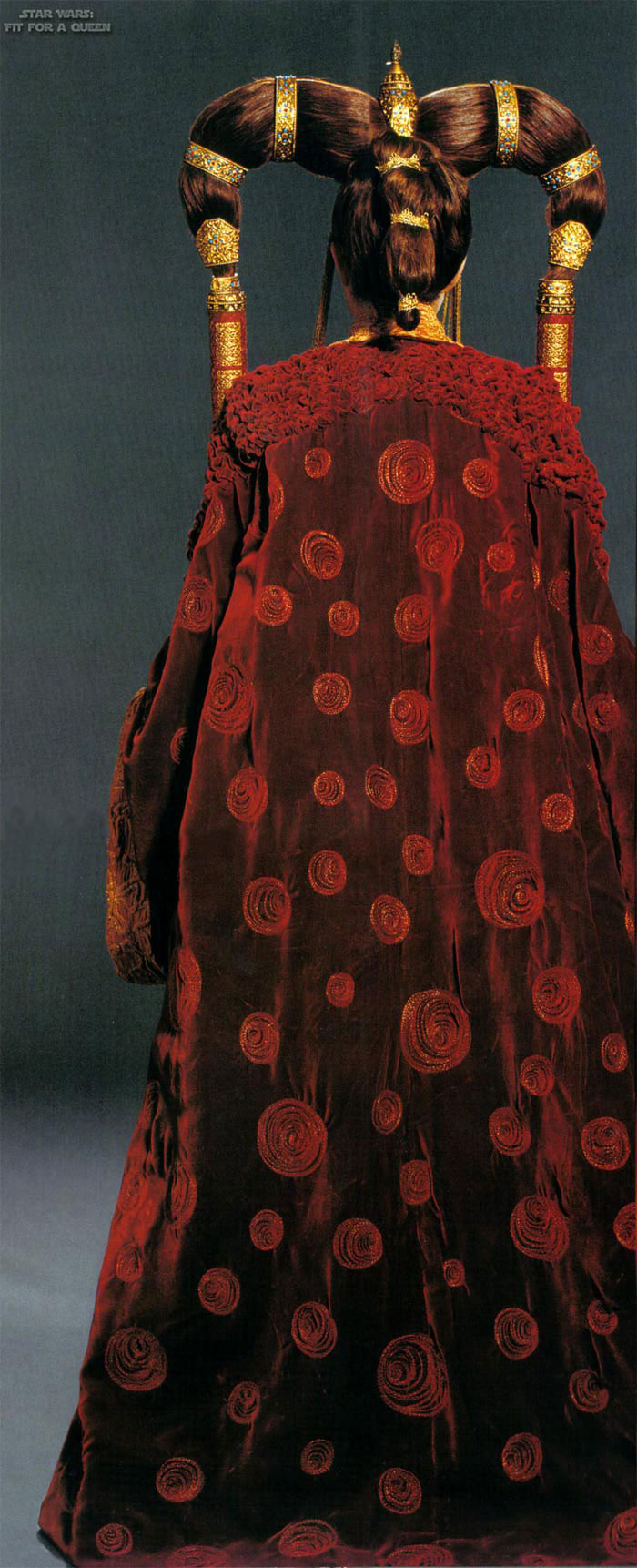
This fabric is similar to the one used in Black Invasion that Amidala wears in Ep. 1. The fabric is very expensive but may help in searching for similar fabric. The link leads to B&J Fabrics, (which we have never purchased from), and this post is only meant to help with fabric ideas. B&J Fabric link for Black Invasion
(This image is of the fabric available at B&J Fabrics)
This listing reads “French Novelty Dimensional Cone-Shaped Coated Viscose-blend in Black. Made in France. Novelty Cone-Shaped. 60% Viscose 24% Polyester 10% Cotton 6% Metallic PU. SKU# 355021. $300.00 per yard. 24″ wide”
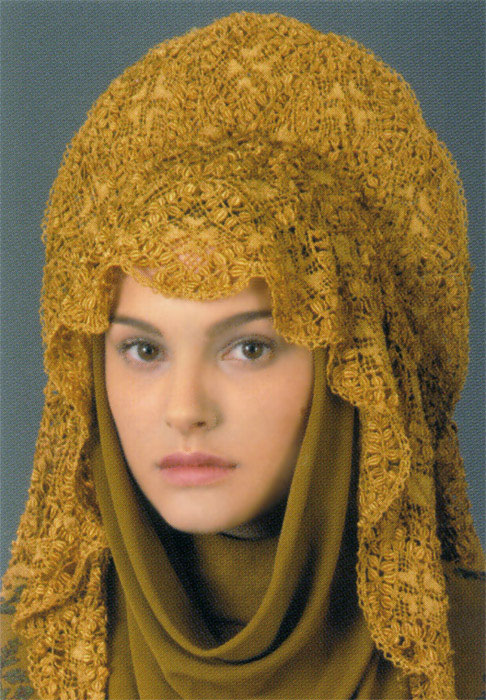
Padmé wears bun covers with her meadow picnic dress from Episode II Attack of the Clones. The bun covers appear to be crochet chain stitch in dark yellow/gold yarn of a small gauge with gold metallic threads. We’ve found a good duplicate in Aunt Lydia’s Crochet Thread. However, the movies likely used a much more high quality material, possible with real gold threats for the metallic aspect of the yarn.
Padmé‘s bun covers are detachable and not part of the hairstyle or headband, here is a picture of one of the sets them sitting in a box back stage before a promo event.
(Padme Picnic Bun Covers From Backstage Costume Look)
Padmé’s bun covers, cover her entire ear and part of the side of her head. They end roughly in line with the back of the neck.
The top edge of the bun covers are roughly in line with the center of the forehead. The bottom edge of the bun cover falls roughly in line with the corner ‘L’ shape of the jaw and Padmé’s lower lip.
(Padmé Bun Covers: Width)
The width of the bun cover is roughly the same width as Padmé’s eye from corner to corner. Or we think somewhere a little over an 1″ish. This will change a little depending on the styling of the bun and the individual.
(Padmé Bun Covers: Flash Shape)
The shape of Padmé’s buns changes a little depending on which image you are looking at. The above image shows the more flat shape, similar to a hockey puck. The below picture shows the more domed out bun shape that also appears. The flatter shape appears more frequently in the movie. The differences is due to the hair inside the buns covers being styling differently and also gravity. The hair dose not appear to be braided inside the buns but instead is loose curls coiled into buns.
(Padmé Bun Covers: Domed Shape)
(Image By: DIY The Galaxy Of Star Wars)
Meadow Picnic Bun Cover Crochet Details:
(Padmé Bun Covers: Chain Stitch)
The bun cover is made out of a gold colored yarn/thread with a metal gold thread intertwined with it. The crochet stitch is a simple chain stitch that is pulled tight so the chain in solid.
The bun pattern is a small center circle with a five petal flower. Around the flower simple chain stitch loops are made all the way around going outwards to the edge of the bun before disappearing behind.
So lets get it out of the way, we know that Leia’s Classic white dress from A New Hope is made out of Silk Crepe De Chine. However, there has been, for a very, very, very long time now a rumor, mounting on a conspiracy, that the dress was made out of Qiana fabric. We here at DIY Galaxy can say that we too have heard and at one point believed this rumor. However, when we started looking into it we found that this rumor doesn’t seem to have any kind of source and directly contradicts real sources from credible places. Digging even deeper we think that Qiana being used really is just an urban legend. Let us explain why.
(To be clear, if you believes that Qiana was used, you are not alone, just about everywhere you go for classic Leia information this rumor is quoted as fact. We here at DIY Galaxy also used to believe this rumor until we starting researching into the fabics. No one should be put down, made fun of or made to feel bad for believing this rumor, and this post is intending to help set the record strait on the fabric fiber, noting else.)
What is Qiana?:
Qiana Fabric “is a silky nylon fiber developed in 1962… Initially intended for high-end fashions, it became a popular material in the 1970s for faux-silk men’s shirts, displaying bold patterns. The shirts were generally cut tight and included wide collars to fit over the collars of the double-knit suit coats, which were worn popularly to discos.”
Why We Don’t Think Leia’s Dress Is Qiana:
The first reason we don’t think Qiana was used, is that the man who made and designed the dress says it was silk. There is documented interview evidence as sources that the dress is made out of silk and not Qiana. We don’t think there is any reason to think that the man who created the dress was wrong about this. So plain and simple we believe the dress creator. There is no reason to believe he lied or was mistaken.
Qiana is said not to stain or mark, this is because its made of plastic essentially, Leia’s dress in the trash compactor and after is covered in marks and stains. Yes, this could be special effort put into make it look this way, however, we believe that this is unlikely and that the dress is made out of silk like the dress designer said it was.
The man who wrote the book, Star Wars Costumes: The Original Trilogy, got to handle the real costumes in person, had access to the people who worked on the movies and had interviews that were given by those people around the time they worked on the movies. We believe that he did his research correctly and that the fabric for Leia’s Classic white dress is Silk Crepe De Chine.
Another reason we think that the fabric is not Qiana is that though it was made as a synthetic silk substitute, it does not look quite like silk. The image below has a red Qiana cap and a pink silk top. If you look closely you can see that the two fibers, though similar, look different in light.
Red Qiana and Pink Silk 1971
We’ve seen some have compared the drape of Qiana to that of Leia’s dress in ANH. This is a good guess, but drape has little to nothing to do with fiber the fabric is made out of. There is a common misconception that the kind of fiber, i.e. silk, wool, cotton, determine the drape of fabric. This is simply not true, drape has more to do with weight and weave. This is the same with shine and mate finishes in fabrics. To that end we don’t think comparing drape in pictures is good enough evidence that Qiana was used. What we can say is that Qiana was made to mimic silk and any similarity between pictures of Qiana dresses and Leia’s dress has more to do with this factor.
It’s likely the dresses that have been compared were made out Qiana that was manufactured to mimic Crepe De Chine Silk, a popular weave and weight for silk.
Another place were the idea different fabrics were used this might be coming from is the fact that two different weights of silk fabric were used between ANH and ESB for Leia’s Classic Dress.
If you look at the two images you can see the difference between the two versions of the dress. In ANH Leia’s dress is more see-through, if you look at her boots you can see them through her dress fabric very easily. This is because the dress in ANH was made out of lighter weight silk then the dress that was made for ESB, which was made out of heavier weight silk. This is talked about in Star Wars Costumes The Original Trilogy book.
You can see through Leia’s dress, look at the boots. ANH
Dress fabric is much thicker and heavier. ESB
Why Do We Think It’s Silk?:
The fabric seen in the movies has the quality of silk, in ANH the silk is reported to be a lighter weight and if you look at movie stills you can see that it is slightly see through. The dress made for ESB is made out of a heavier fabric so the see through aspect of the dress is not a problem. The drape and differences between the dresses is the weight of the fabric used rather then the fiber.
Star Wars Costumes The Original Series: A New Hope
Star Wars Costumes The Original Series: The Empire Strikes Back
Lets also look at the fact that Lucas was basing his films off of old movie serials from the 1930’s and Japanese films. Both of which used wool and silk a lot in their costumes.
Larger Fabric Theory Of Star Wars:
We already have a post on Fabric Theory in Star Wars which is linked here in its entirety. In a nut shell, however, good guys wear natural fibers and bad guys wear plastic.
Possible Reasons Where the Qiana Idea Came From:
We may never knew where the idea that Leia’s dress was made out of Qiana came from but here are a few theories we have.
In the early days of costuming web sites someone may have suggested it as a fabric and from there it spun out of control. As we had almost no resources of fabric fibers in the early days, not a bad guess, but not an accurate one either.
The Halloween costume pattern that was put out in the 1970’s may have had Qiana listed in their suggested fabric in its ‘for this project’ section. (Please note that these 1970’s sewing patterns are not movie accurate. Whatsoever.)
For a long time the low budget legend of Star Wars movies has been around, its been said that actual curtains where used or old blankets to make some of the costumes. For the most part this is not true, its a legend, or has been blown out of proportion. However, Qiana being cheaper then silk might be where it comes into the costuming community.
There does seem to be a permeating idea that everything in the 1970’s was made out of polyester, and lets be fair a lot was, and I mean a lot. But this is exactly why Lucas wanted natural fabrics, he wanted a different look for his movie then all the other polyester and spandex sci-fi films that were coming out from the 1960’s to 1970’s.
There seems to be a white whale aspect about this fabric, that if you can just find the supper rare Qiana you’ll have the most accurate dress. Which fuels the rumor sticking around, we all love a good mythical fabric story. : )
There also seems to be in some circles a desire for the dress to be hard to figure-out and make, which is also fueling a desire for the fabric to be impossible to find.
Qiana and Silk Dress 1971 [pink silk top, red Qiana skirt]
Description: ‘Red and Pink 1971 Gown Qiana and Silk’
“Red Qiana jersey cape, skirt and headwrap/halter top with a pink silk gauze wrap top with spaghetti straps. Long skirt is A-line and bias with narrow 1 waistband. Cape is full length to the floor with a fitted yoke that has double self-fabric buttons on front and bound buttonholes. Hems of skirt and cape are unfinished clean-cut. Pink top has gathers and sewn darts to control fullness at front that is sewn to long ties that wrap around back and tie in front.” From Fashion2Fiber The Ohio State [more images in link]
When looking closely you can see that the difference between the pink silk top and the red Qiana skirt of this 1971 dress. Those two fabrics look similar because Qiana was designed to mimic the look of silk. One reason for this similarity in look comes from the fact that Silk threads the make up the fabric are a Filament Fiber, meaning that it is made from one long unbroken thread. Silk is one of the only natural Filament fibers that cloth is made out of. Man-made fibers are also often Filaments such as polyester like Qiana.
Qiana and Silk Dress 1971 [pink silk top, red Qiana skirt]
“Staple and filament fibers: On the basis of length, fibers have two categories: staple and filament. Filament further classified as mono filaments and multi-filaments.
Any fiber with a practically limited or finite length is called staple fiber. These are small length fiber like cotton, wool, jute etc. Most natural fibers are staple fibers. Natural fibers are those fibers that are directly collected from nature usually from plants or animals. The common natural fibers are cotton, wool, silk, jute and flax. Fibers from plants and animals are constructed directly in nature have very large molecule of polymers.
Filament is a fiber that manufactured is continuous to near continuous lengths for use. All fibers having a practically unlimited or infinite and endless-fiber length are called filaments. Filament fibers may be produced as mono (single) or multi (10-100) filament type. Most manufactured fibers are produced at filaments form. The length of filament may range from a few hundred meters to several kilometers. Filaments can be converted into staple fiber by cutting of specified length. Staple polyester and viscose are available in market for blending with staple cotton fiber.
Length: Length is the most important factor for assessing the value of a fiber. Most natural fiber is of limited length, commonly a few millimeters to several centimeters. Silk is the exception, being formed as filament, which may be 500-2000 meter in length.” From (TextileBlog.com).
Image by: DIY the Galaxy of Star Wars – Image from Dressing a Galaxy, Trisha Bigger author.
Text Transcript:
Silk cloqué bodice with seven-color computerized filigree embroidery with bled stitching. The roses were taken from the tulle and appliqued on top to unite the two fabrics. The bodice is worn over an old-gold silk organza with multicolored ribbon detail around the lower sleeves.
Image by: DIY the Galaxy of Star Wars: Image from Dressing a Galaxy
Image by: DIY the Galaxy of Star Wars: Image from Dressing a Galaxy
“A Cloque or cloqué (French for “blister” or “blistered”), occasionally abbreviated clox, is a cloth with a raised woven pattern and a puckered or quilted look. The surface is made up of small irregularly raised figures formed by the woven structure. The Americanized spelling is “cloky”.”- Wikipedia.